AG AMERICAN GULF E N T E R P R I S E S

Point Comfort, Texas · Fort Worth, Texas

Drawn on a sheet.
Built on the coast.

Follow a ton of portland cement from a limestone bluff to your batch plant — across the Gulf, through our own Siwertell at Point Comfort, and north to Fort Worth on our own rail. Import, terminal and distribution — without a hand-off in the middle.

TIDELINE MONOGRAM AG
ProjectGulf Cement Chain
ClientAmerican Gulf Enterprises
Sheet1 of 13
ScaleAs shown
Scroll
Act I · Landfall Sheet 01 / 08
01

It starts as a limestone bluff

Cement begins as rock. At the quarry the face is drilled, blasted and hauled to a primary crusher — roughly a ton and a half of raw material for every ton of finished cement.

Our supplier's quarry
02

Ground, burned, ground again

The raw mill grinds the stone finer than flour. It falls through a preheater against the rising gas, then down a rotary kiln to about 1,450 °C, where it half-melts into clinker. Cooled, then ground once more with 3–5% gypsum — and it is cement.

Raw mill · kiln · cement mill
03

Landfall at Point Comfort

A chartered bulk carrier comes up the Matagorda ship channel and ties up at our own berth on the Calhoun Port Authority dock. No lightering, no transhipment, no waiting on someone else's window.

Point Comfort, Texas
04

Our dock, our window

The unloader travels the length of the wharf on rails at a 45-foot gauge and slews out over the hatches. Because the berth is ours, the vessel works to our schedule rather than a queue.

Rail gauge 13 716 mm · travel 2 × 76 m
05

The Siwertell

A MacGREGOR screw-type ship unloader, rail-mounted on the dock. The boom slews out over an open hatch and lowers a vertical conveyor into the cargo — an arm that hangs plumb whatever the boom is doing. This is the machine the whole terminal is built around.

ST-940 D · reach 25 251 mm · arm 23 750 mm
06

It digs, it doesn't suck

The trick is at the bottom. A counter-rotating inlet feeder takes cement from below the cargo surface — so the dust never gets airborne — and its outer casing turns against the screw inside it. That opposition is what fills the conveyor: from about 15% full to about 80%.

Counter-rotating inlet feeder
07

Up a sealed screw

From the feeder the cement climbs 23.75 metres inside a closed tube. The bearings sit in the tube wall rather than the middle, so the screw flight runs unbroken end to end — nothing to catch on, nothing to shed, nothing open to the air.

Enclosed vertical conveyor
08

Across, and down the turret

At the top an enclosed chute hands the cement onto a belt running inboard along the boom. It drops through a chute on the slewing axis itself — so the boom can swing anywhere over the ship without ever breaking the line — and onto the jetty conveyor.

Boom belt 1 600 mm · slew ±110°
09

Ashore, under cover

From the unloader the cement runs inland along a covered jetty conveyor to storage. From the ship's hold to the silo it is never open to the weather — which is the difference between cement and a ruined cargo.

Enclosed belt, 1 600 mm
10

North by rail

Covered hopper cars take the cement off the coast and up to North Texas. Loading into our own cars on our own track means the cost of the move is a number we control, not one we are quoted.

Pressure-differential covered hoppers
11

Fort Worth — 2000 South Main

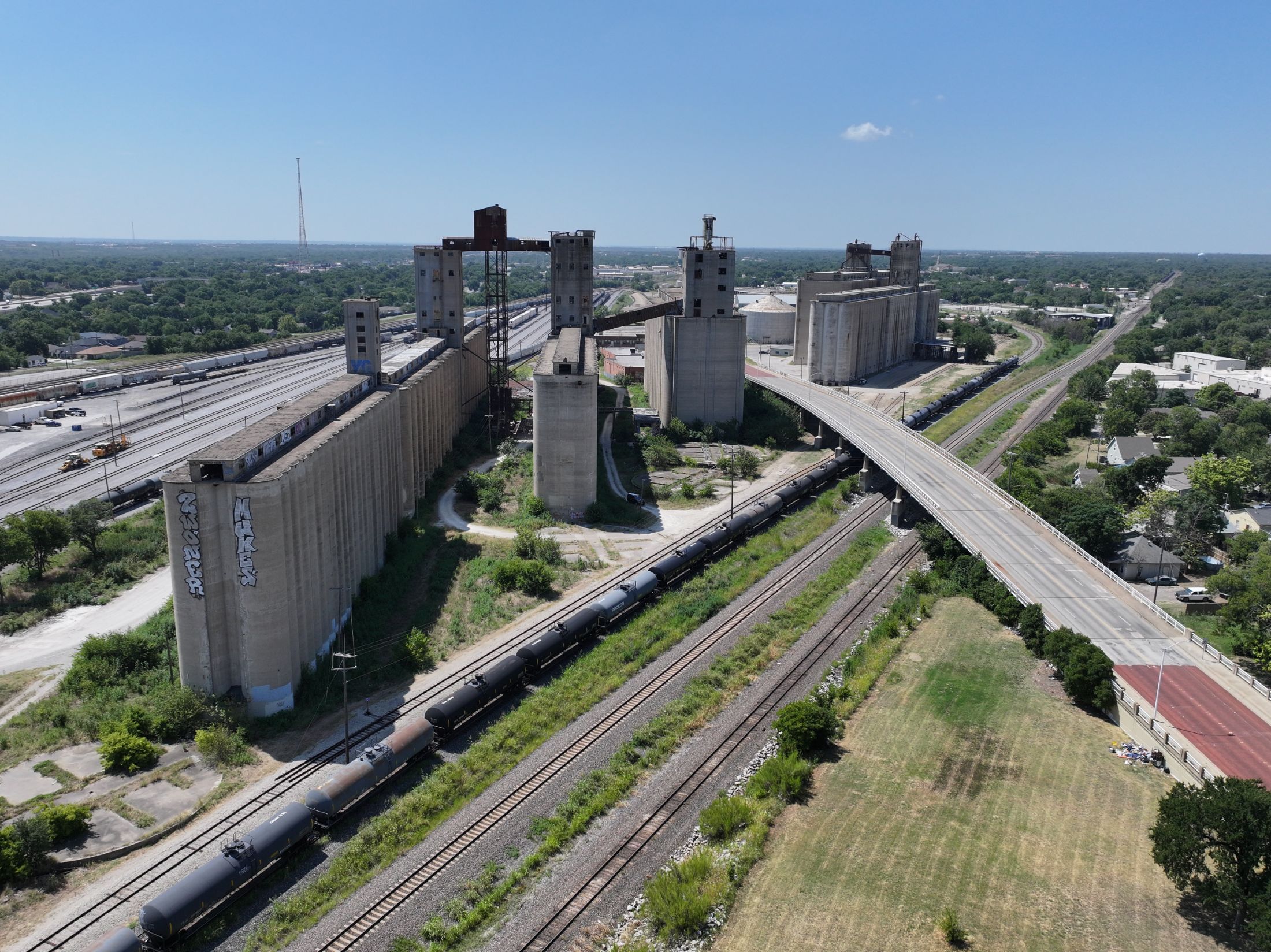
The cars arrive at the Main Street Terminal, a concrete silo complex hard against the yard in south Fort Worth. Rail comes in one side; trucks load out the other.

Main Street Terminal, Fort Worth
12

Into storage

Cement is lifted into the silo battery and held under aeration until it is called for. Displaced air goes out through a baghouse rather than into the neighbourhood.

Aerated cone discharge
13

Onto your truck

A pneumatic tanker pulls under the spout, the sock seals to the hatch, and the load goes in closed. It is weighed on the way out and ticketed on the spot. One company from the ship's hold to this hatch.

Weighed & ticketed on site
The chain, written out

Thirteen steps between a limestone bluff and your batch plant.

The same thirteen stops as the drawing above, in plain text.

01

The quarry

Limestone is drilled, blasted and hauled to a primary crusher — about 1.6 tons of raw material per ton of finished cement.

02

The plant

The raw mill grinds the stone finer than flour. A preheater and rotary kiln burn it to roughly 1,450 °C into clinker, which is cooled and reground with 3–5% gypsum into cement.

03

Landfall at Point Comfort

A chartered bulk carrier comes up the Matagorda ship channel and berths at our dock on the Calhoun Port Authority waterfront.

04

Our dock, our window

The unloader travels the wharf on rails at a 45-foot gauge and slews out over the open hatches. The berth is ours, so the vessel works to our schedule.

05

The Siwertell

A MacGREGOR ST-940 D screw unloader, rail-mounted on the dock. The boom slews over an open hatch and lowers a vertical conveyor into the cargo.

06

The inlet feeder

A counter-rotating feeder takes cement from below the cargo surface, so dust never gets airborne. Its casing turns against the screw inside, lifting the fill factor from about 15% to about 80%.

07

Up a sealed screw

The cement climbs 23.75 m inside a closed tube. Bearings sit in the tube wall, so the screw flight runs unbroken end to end.

08

Across, and down the turret

An enclosed chute hands onto a belt along the boom, which discharges through a chute on the slewing axis — so the boom can swing without breaking the line.

09

Ashore, under cover

A covered jetty conveyor carries the cement inland to storage. It is never exposed to weather between the hold and the silo.

10

North by rail

Covered hopper cars move the cement off the coast and north to Fort Worth on rail we control.

11

Fort Worth — 2000 South Main

The cars arrive at the Main Street Terminal, a concrete silo complex against the yard in south Fort Worth.

12

Into storage

Cement is lifted into the silos and held under aeration. Displaced air is filtered through a baghouse.

13

Onto your truck

A pneumatic tanker loads under a sealed spout, is weighed on the way out, and is ticketed on site.

Two terminals

The coast and the metroplex, on one balance sheet.

Most cement in Texas changes hands three or four times between the ship and the pour. Ours changes hands once — when it goes into your truck.

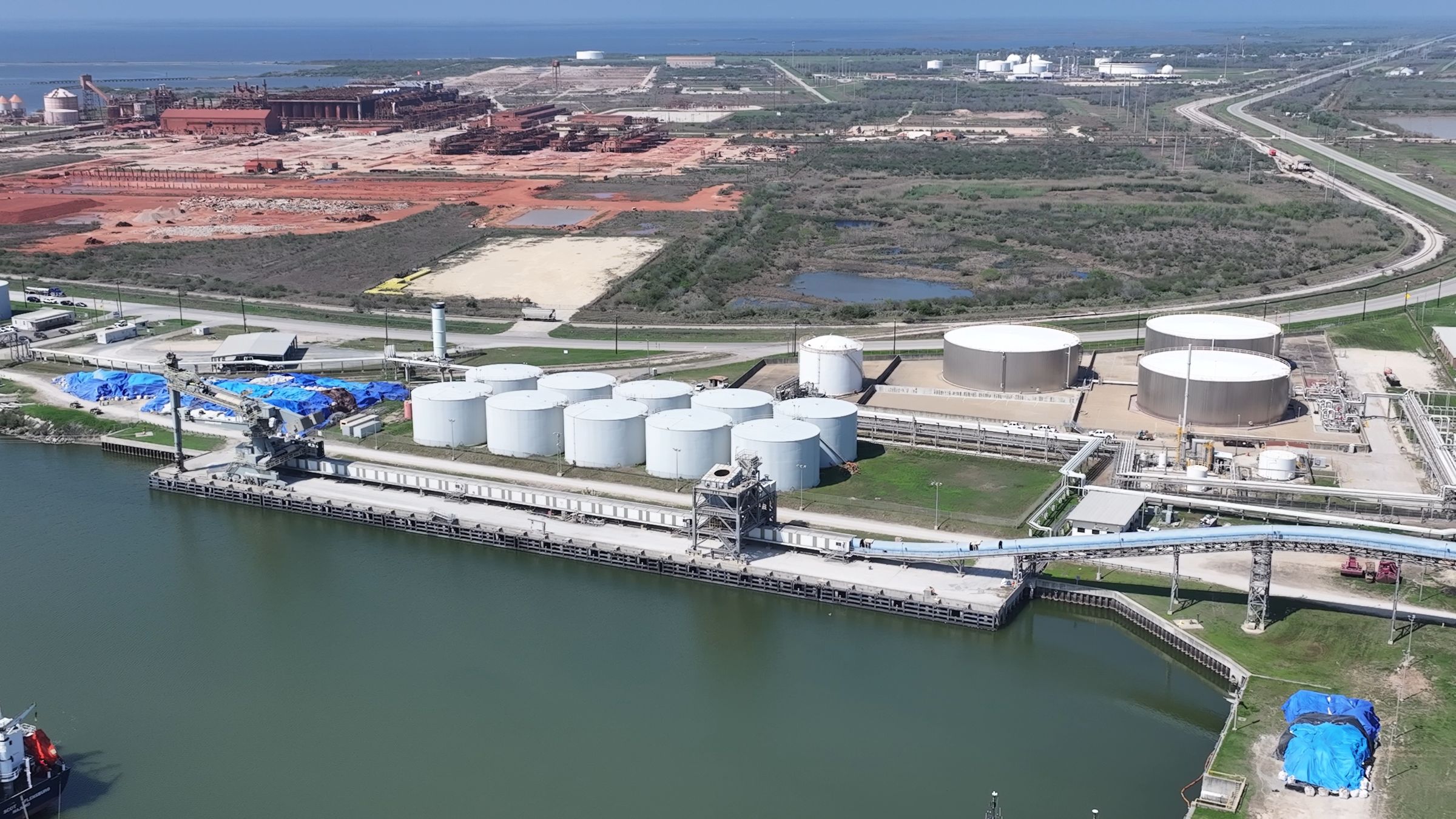
Aerial view of the American Gulf dry bulk dock at Point Comfort, Texas, showing the ship unloader, the covered jetty conveyor along the wharf and the tank farm behind it.

Marine · Point Comfort, TX

Point Comfort Marine Terminal

A deep-water dry bulk berth on the Calhoun Port Authority waterfront, with a screw-type ship unloader and enclosed conveying straight to storage.

  • MacGREGOR / Nordströms Siwertell ST-940 D screw unloader
  • Rail-mounted gantry, 13 716 mm gauge, 2 × 76 m of travel
  • Covered jetty conveyor — enclosed hold-to-silo
  • Direct access to the Matagorda ship channel
Aerial view of the Main Street Terminal in Fort Worth: a row of concrete storage silos alongside a rail yard, with covered hopper cars on the track and the South Main Street overpass crossing the site.

Rail · Fort Worth, TX

Main Street Terminal

A concrete silo complex at 2000 South Main Street, hard against the yard — rail in on one side, truck loadout on the other.

  • Concrete silo battery with headhouse and annex
  • Rail receiving pit and bucket leg
  • Covered truck loadout with sealed spouts
  • On-site weighing and ticketing

Operations & developments

The rest of it, in detail.

Each of these is a working page in its own right — the machinery and the sites behind the chain above.

By the numbers

A chain you can measure.

13StepsLimestone bluff to your hatch
2TerminalsPoint Comfort & Fort Worth
1Hand-offInto your truck, and no sooner
25.2 mUnloader reachSlew axis to vertical arm

Capabilities

Importer, terminal operator, and the truck at your gate.

Each of these is normally a separate company taking a separate margin. Running them together is the whole point.

Cement importing

Chartered tonnage brought in against our own berth window.

Marine terminal

Discharge, enclosed conveying and storage on the water.

Rail logistics

Covered hoppers from the coast to North Texas.

Truck distribution

Pneumatic tankers loading under sealed spouts.

Weighing & ticketing

Certified weights and a ticket in the driver's hand before he leaves.

Quality assurance

Cement kept enclosed and sampled through the chain.

Get a price

Tell us the job. We'll tell you the landed price.

Volume, spec, where it's going and when you need it. Because we own the berth, the rail and the terminal, the number we give you is the number — not a quote built out of three other people's quotes.

Corporate
American Gulf Enterprises
Point Comfort, Texas
Email
info@americangulfcorp.com
Terminals
Point Comfort, TX · Fort Worth, TX