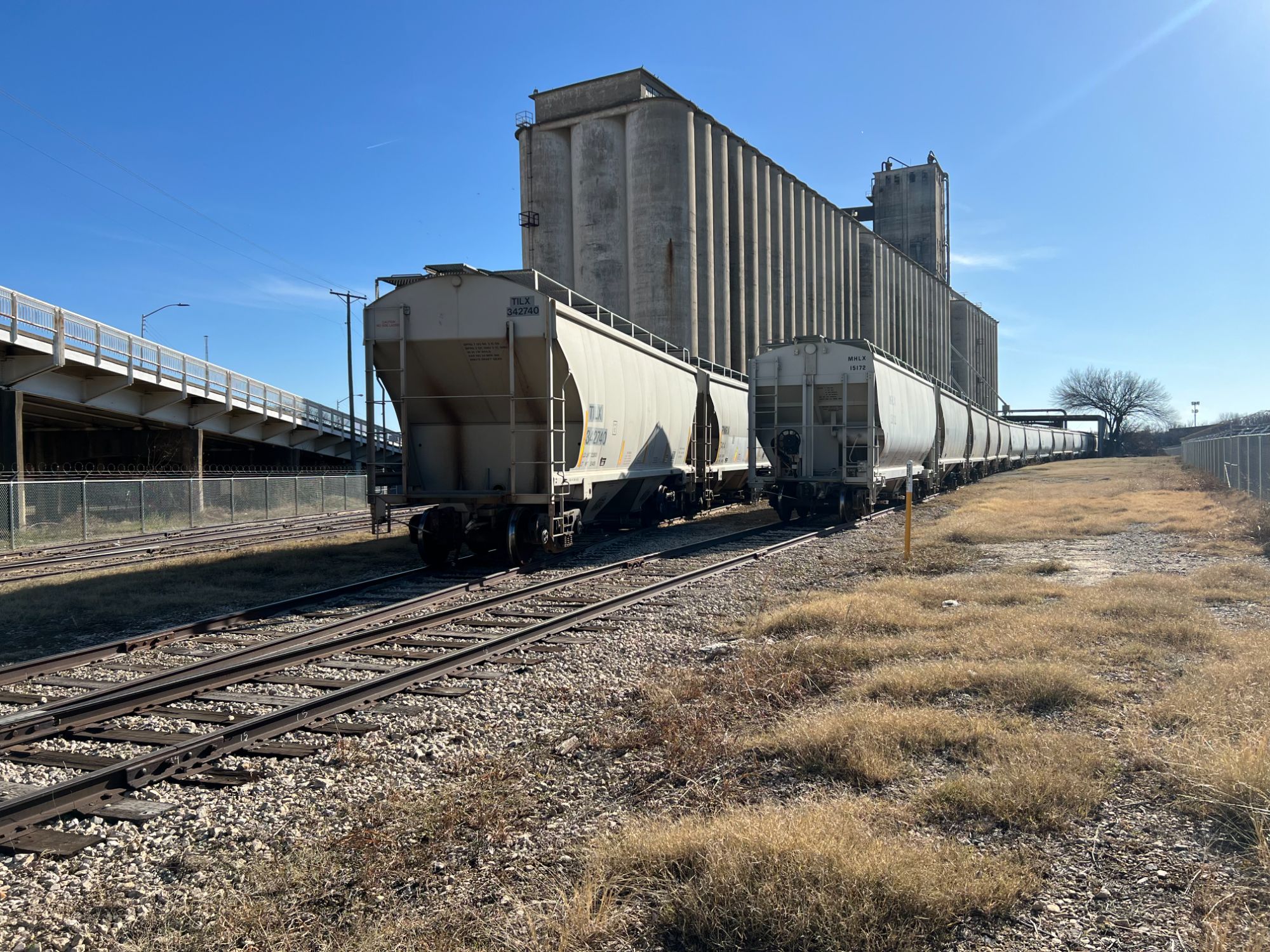
Main Street Terminal · Fort Worth, Texas
The car rolls over the pit. A connector rises out of the ground, seals against the discharge gate, and the load drops straight into an enclosed belt. Nobody goes under the car, and nothing is ever open to the weather.
A string of covered hoppers arrives at the Main Street Terminal off the coast run. They stand on the receiving track with a pit underneath them that you would never notice from the ballast.
Main Street Terminal · Fort WorthThe car is pulled forward until one discharge gate sits square over the pit opening. Everything that follows depends on this: the spot is the job.
3 285 cf · two bays · 41'-10½" over pulling facesA concrete pit, a receiving hopper, and a connector parked below the top of rail — far enough down that a train can run over it at speed and never touch it.
Gate sits 1'-6½" above the railAir over hydraulic lifts the head about two feet, straight up through the slot in the deck, until a compression gasket meets the underside of the car's discharge frame and stops.
No one goes under the carThe gasket squashes against the steel and the joint closes. From here to the silo the cement is inside a sealed system — and because the connector keeps rising as the car lightens, the seal holds from full to empty.
Sealed, full to emptyThe gravity slide runs back and a hundred tons of powdered cement drops into the boot. Displaced air goes back up into the car, because there is nowhere else for it to go. Nothing plumes, nothing blows away.
~116 tons per carBelow the pit the cement lands on a covered belt in a tunnel, running under the track toward the elevator. Covers the whole length, skirted at the loading point, no open transfer anywhere.
Covered, skirted, continuousAt the end of the belt a leg picks the cement up in buckets and carries it to the top of the silos in one closed column. Displaced air goes out through a baghouse, not into the neighbourhood.
Enclosed casing · filtered ventA gravity distributor at the head sends the load to whichever silo is called for, and it is held under aeration until a truck comes for it.
Aerated cone dischargeThe connector drops clear, the puller takes up the slack, and the next gate comes over the pit. One car at a time, all day, without a shovel or a man underneath.
Then the whole thing againThe process, written out
The same ten steps as the drawing above, in plain text.
A string of loaded covered hoppers is delivered to the receiving track.
A car puller indexes the string until a discharge gate sits square over the pit opening.
A concrete pit holds a receiving hopper and a connector parked clear of the wheel envelope.
Air over hydraulic lifts the head about two feet, up through a slot in the deck, to the car's gate.
A compression gasket closes against the discharge frame, and the joint stays shut for the whole discharge.
The gravity slide runs back and the load drops into the boot. Displaced air returns to the car.
A covered belt in the tunnel carries the cement from the pit to the foot of the elevator.
A leg lifts it in closed buckets inside a closed casing; displaced air is filtered through a baghouse.
A gravity distributor at the head routes the load into whichever silo is called for.
The connector drops clear and the next gate is indexed over the pit.
The car
The equipment on the drawings above is a two-bay pressure-plate covered hopper built for cement and sand service. These are the figures the unloading pit is sized around.
Figures taken from the car's own general specification sheet (3 285 cf two-bay 286K covered hopper). The connector shown on the drawings is drawn generically — it is not any manufacturer's drawing, and no product is named.
By the numbers
Why it matters
Open pits lose product to the wind, put people under standing cars, and stop when it rains. A sealed under-track connection fixes all three at once.
The gasket seals to the discharge frame, so the drop is inside a closed system.
The connector comes up to the gate. Crews work from the deck, never beneath standing equipment.
A sealed connection does not care about wind or rain, so a wet week does not become a lost week.
Connect, discharge, drop, index. Demurrage is a function of how long a car sits.
What blows off the pit is cement you bought and cannot sell. A sealed drop keeps the ticket honest.
No plume off the track, no grey drift on the fence line, no cement in the ballast.
Get in touch
American Gulf imports portland cement across the Gulf, discharges it at our own Point Comfort berth, moves it north by rail, and unloads it here. One company from the ship's hold to your truck.